

Aquatic Wildlife
Our becks flowing from the Moorside into the River Wharfe, the main river itself and our village ponds are home to a large range of aquatic wildlife. The overall picture in terms of population trends is very mixed, mainly, but not entirely, negative. We know from historical records that trout were more abundant in the past and that native white-clawed crayfish have been lost, to be replaced by non-native invasive signal crayfish. On the other hand otters are being seen more often and are expanding their range.
We have little data on birds but grey wagtails, dippers, kingfishers, and herons are frequently observed especially on the main river. Mallards occur commonly in the village and little egrets have been recorded on the river and the lower reaches of Town Beck in recent years.
If you would like to help please see the Contact Form on this page to see how to send your sightings to us.
Click on the links below to move to your subject of interest.
Brown Trout (Salmo trutta) and other fish
In 2016 we invited Jon Grey of the Wild Trout Trust to carry out a walkover survey of the lower reaches of Town Beck and Back Beck. His report was not concerned with the presence or absence of trout but with habitat quality. It especially identified the presence of barriers, such as weirs and culverts, on both becks restricting the movement of fish up and downstream.
Electro-fishing by Jon Grey on a number of occasions in the becks since that initial survey has shown the presence of trout in Town Beck as far upstream as the Lord Addingham pub and in Back Beck as far as Bridge 55. The very high step in the beck at Bridge 55 presents an impassable barrier to upstream movement. However, trout are present in the beck further upstream, at the back of Burns Hill, indicating the presence of a self-sustaining population there, isolated from the main river.
Jon Grey has also electro-fished Lumb Beck finding a trout presence close to the head of Lumb Ghyll Wood although none was detected in the lower reaches. Lumb Beck has a very poor connection with the main river with respect to fish passage, so we believe this is another example of an isolated population.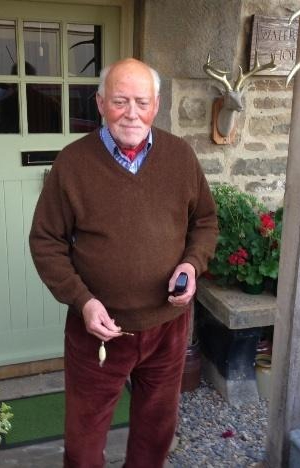
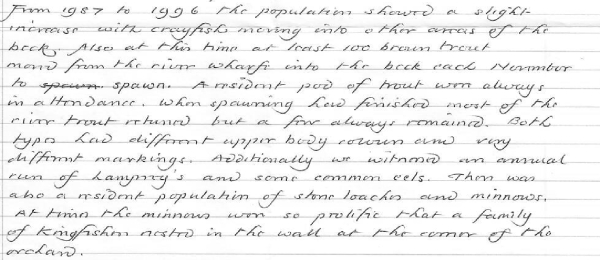
Evidence for a decline in trout numbers (and other fish) in Town Beck over the years is provided by the records kept by Derek Law, now deceased. On the 16th January 2018 Mr Law wrote to Rick Battarbee about his observations on the populations of trout (and crayfish) in the Beck in Church Field from 1983 to the present day (2018). An excerpt from his letter is shown here.
Trout, stone loach (Barbatula barbatula) and minnows (Phoxinus phoxinus) are still present in Town Beck in the stretch immediately upstream of the bridge marking the exit of the beck from Church Field, but there has been a major decline in trout numbers and we have no recent record of eel sightings. Bull heads (Cottus gobio), also called Miller’s Thumb, are quite common and occur in all becks.
Crayfish, white-clawed (Austropotamobius pallipes), and signal (Pacifastacus leniusculus)
Native white-clawed crayfish were once common in the Church Field stretch of Town Beck. Derek Law’s letter (see above) states he counted between 40 and 55 individuals in 1984, 1985 and 1986, with increasing numbers from 1987 – 1996 followed by a steep decline. He associates the decline with a marked increase in floodwater events and changes to the bed of the channel, and not with the arrival of signal crayfish.
His first record of the invasive non-native signal crayfish species which now occurs in some abundance in the beck was not until 2007, many years after the demise of the native species. Signal crayfish (see picture) now occur not only in Town Beck (as far upstream as Townhead), but also in Back Beck (as far as Bridge 55). They have also been seen on Lumb Beck as far upstream as Throstle Nest. None so far has been seen on Wine Beck.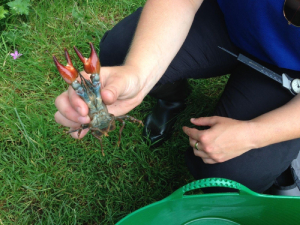 In the summer of 2020 Jack Greenhalgh from the University of Bristol carried out a survey of our Addingham becks as part of his PhD on the use of eDNA to detect crayfish. Our volunteers helped by conducting hand-searches for crayfish individuals at each eDNA sampling point. He found a close agreement between the results of the manual searches and the eDNA data, and also detected the presence of signals in Lumb Beck from the eDNA although no individuals at the time were found by hand searching. Signals have subsequently been seen in Lumb Beck, demonstrating the usefulness of eDNA. The study was published in the journal Environmental DNA with our volunteers as co-authors. Click here to see the article.
Otters (Lutra lutra) and mink (Neovison vison)
In line with national trends otter numbers on the Wharfe have recovered strongly in recent years with sightings not only in the main river but also in Town Beck. They are predators feeding on fish, crayfish and waterbirds, such as moorhen and mallard.
Otters were almost completely wiped out in the UK by the 1970s due to problems of water pollution by pesticides and habitat destruction. Their recovery is due to improvements in water quality, especially following the ban on harmful pesticides, to legal protection, especially the introduction of the Wildlife and Countryside Act 1981 and to conservation efforts by the Yorkshire Wildlife Trust.
We caught an adult with two cubs on a trail camera in a garden next to the beck in Church Field in May 2018 and there have been several sightings in and around the Saw Mill Dam in early 2026, one also caught on camera.
However, threats remain. Otters are increasingly disturbed along the Wharfe, especially in Ilkley, as dogs are allowed to roam along riverbanks and enter the water, and there have been a number of accidents on the roads, most notably recent mortalities on the Addingham bypass and on Bolton Road close to Farfield Hall.
Whereas we welcome the recovery of our native otters we are less happy about the presence of mink. Mink are non-native invasive species. They escaped from fur farms and spread rapidly throughout the UK in the 1950s and 60s.
They have been sighted in the Wharfe on numerous occasions including most recently in Town Beck near the Townhead Trading Estate in January 2026.
They are powerful predators, responsible for decimating native water vole populations. Efforts to trap mink in Yorkshire are ongoing, especially by the Yorkshire Wildlife Trust. There is also some evidence that otters are capable of predating on mink.
Otter in Sawmill Pond captured by Mark Preston
Daubenton’s bats (Myotis daubentonii)
Of the number of bat species that occur in the village only one, the Daubenton’s bat, is dependent on water, as it feeds almost exclusively on prey scooped from the water surface (see picture, courtesy of John Altringham) or on airborne insects immediately above the water. On the Wharfe it has been intensively studied by John Altringham and his students from Leeds University. His work demonstrated not only the importance of protecting the river habitat and its wooded riparian zone to maximise insect abundance and provide roosts, but also the importance of the whole river corridor from Ilkley upstream to Buckden in providing habitat for all stages of its lifecycle. Males and females come together to mate at central locations such as Grassington but then spread out with males heading upstream and females downstream.
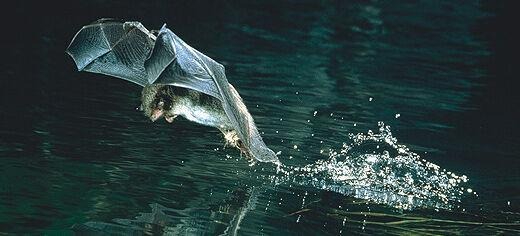
They occur in Addingham and have been sighted recently, in 2025, on the Wharfe near the Suspension Bridge, probably from a roost in trees close to Church Field. However, numbers have almost certainly declined over the last few decades. John Altringham identified a roost of approximately 100 individuals in the gable wall of the old mill building at Low Mill, now converted into flats and called Mill Fold, prior to the conversion. Although entry points to the gable wall were built in at the time more than in an attempt to protect the population, inspection of the site in 2025 showed no evidence of re-occupation.
Click here for more information on bats in Addingham.
Amphibians
Amphibians (frogs, toads and newts) are the most threatened of all animals dependent on freshwaters, globally and nationally. All depend on the availability of suitable water bodies (mainly ponds) to breed.
Frogs (Rana temporaria)
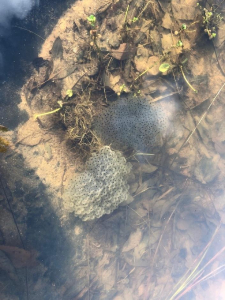 Whilst the common frog is indeed common and widespread in the UK its population is declining, mainly due to habitat loss. However, research shows that populations can be increased by building ponds. We have created several ponds on village allotments and in the Primary School Jubilee reserve, and we encourage residents to build ponds in their gardens (front or back) (see here). Some but not all of these have been successfully used for breeding. The frog spawn in the picture is from one of the two new school ponds.
More ponds are needed and more frogs are needed. Please report sightings of frog spawn in spring and frogs anywhere (often in long grass) at any time during the year, and put a pond in your garden! But a word of caution, don’t be tempted to move frog spawn around. You may be helping to transmit disease and/or introduce propagules from invasive species.
Toads (Bufo bufo)
The common toad is widespread in the UK but its numbers are declining sharply. It prefers to breed in somewhat larger and deeper ponds than frogs and has a very strong affinity to its spring breeding sites. There are well documented sites in Otley and Menston but none that we are aware of in Addingham. Indeed we only have one recorded sighting of a toad in the village. That was in 2025 in the Dawson Crossley Field. If you see a toad anywhere in the village, take a picture and please let us know.
Newts
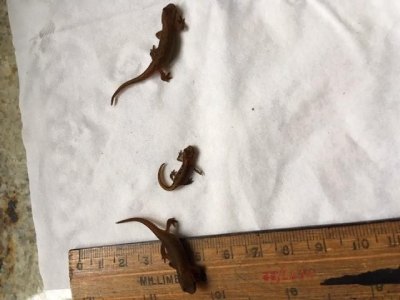 There are no known records of the famous great-crested newt in the village, but the smooth newt (Lissotriton vulgaris) is almost certainly here. It is likely to occur in most garden ponds even if it is not always seen. The palmate newt (L. helveticus) is very similar in appearance and size as the smooth newt and also has a widespread distribution. As the two species are difficult to tell apart (without a close inspection), we don’t know at this stage what their relative abundance is or indeed whether both species occur in the village. The picture shows juvenile newts (“efts”), assumed to be smooth newts, from a pond in the back garden of a house in Main Street.
Dragonflies
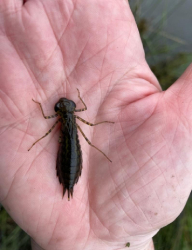 Dozens of different invertebrate species occur in our becks and in the river. Many are the larval stages of insects such as mayflies, caddis flies, stoneflies and non-biting midges, all essential food supply for fish and birds. The most charismatic insects, however, are damselflies and dragonflies, more often found in ponds and wetlands rather than in running water. The nymph of the Southern Hawker (Aeshna cyanea) is the most spectacular dragonfly seen commonly in the village. Its larval stage (see picture), lasting two to three years, takes place in ponds where it feeds voraciously on other insects, tadpoles and newt efts.
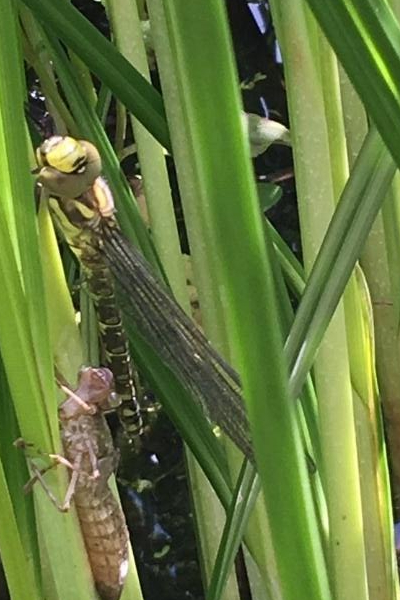
When fully grown it crawls up the stems of emergent reeds and emerges as an adult leaving its larval case (exuvium) behind (see picture). Other dragonflies have been seen in the village but we as yet do not have good definitive records. Please send us any sightings.
Birds
We have many birds that are seen along the main river and our becks but not so many that are dependent on aquatic habitats. The truly water dependent birds include:
Dippers (Cinclus cinclus)
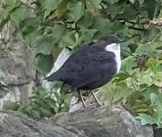 These very distinctive birds nest each year under the arched mill race at High Mill on the Wharfe and intermittently on Town Beck between Beckside Close and Townhead.
They are excellent underwater swimmers and rely on aquatic insect larvae, such as caddis fly larvae, as a food supply. We observed a family with chicks in June 2022 where the beck emerges from the culvert under 29 Main St. A local resident, took the photograph shown here on the wall top at the same location on November 17th 2025.
Grey wagtails (Motacilla cinerea)
Grey wagtails are seen every year along Town Beck between Townhead and Burnside. They are widespread across the UK alongside becks and rivers. Like dippers they feed on aquatic insect larvae.
Kingfishers (Alcedo atthis)
Kingfishers seem to be doing well in the Wharfe. It’s common to see one flying along the tree-lined south bank near the Suspension Bridge. They also fly up Town and Back Becks from time to time and have been seen perching on a branch next to the Saw Mill Dam. Derek Law noted that they were more common in Church Field prior to 1990 with a pair nesting in the wall at the corner of the orchard, reflecting at that time the abundance of minnows, their favourite food, in Town Beck.
Grey Heron (Ardea cinerea)
Grey Herons occur quite commonly both along the Wharfe and in the lower reaches of our becks. They are also well known to visit garden ponds in the village looking for fish. They will also take ducklings, frogs and small mammals
 Little egret (Egretta garzetta)
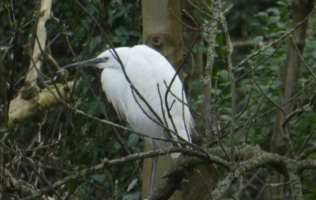
Little egrets, also called cattle egrets, are now commonly seen in Yorkshire, including along the Wharfe in Addingham and Ilkley. They have spread north rapidly since 2017, probably as a result of climate change. An individual was seen by the Saw Mill Dam in 2024 (see picture by Anne Clarke).
Mallard (Anas platyrhynchos)
Mallards are the most common waterbird in the village although their numbers have declined somewhat in recent years, possibly as a result of duckling predation by otters and herons. They can be seen all year round on the Saw Mill Dam. They are omnivorous feeding on plant material, insects and snails. On the Saw Mill Dam the water is cloudy as their feeding behaviour on the bottom leads to the muds being disturbed and resuspended in the water column.
Moorhen (Gallinula chloropus)
Moorhen have an amber-listed conservation status but they are quite widespread in the village occurring on the Saw Mill Dam and also on ponds on Bracken Ghyll Golf Course. They are much more secretive than mallard but their feeding behaviour can also lead to habitat damage, especially the loss of aquatic plants.
Other waterbirds sighted are Mandarin ducks (Aix galericulata), an introduced species to the UK, native to East Asia, goosanders (Mergus merganser), cormorants (Phalacrocorax carbo) and oyster catchers (Haematopus ostralegus) frequently seen on the Wharfe between High and Low Mill in particular.
Click here for more information on birds in Addingham.